Roofing website design that brings in calls is built around one moment: a homeowner with a problem, usually on a phone, deciding who to contact. The site has to show what you do and where you work, prove you are trustworthy, and make calling or requesting an estimate effortless. Service pages, a fast estimate form, reviews and real local information do more for a roofer than any amount of decoration.
Here is what I put on every roofing and home service site, and what happened when I rebuilt one for a five-star roofer in Virginia.
A five-star roofer with a five-minute website
Three Rivers Roofing had great reviews and a website that did not match them: a few paragraphs and a contact button. No lead capture, no real service information and no SEO. People who found them had to already know who they were.
After the redesign, organic leads went from 2 or 3 a month to 1 to 3 a day, and Google’s AI now recommends them when people nearby search for a leaking roof. The full story is in the Three Rivers Roofing case study. Here is what made the difference.
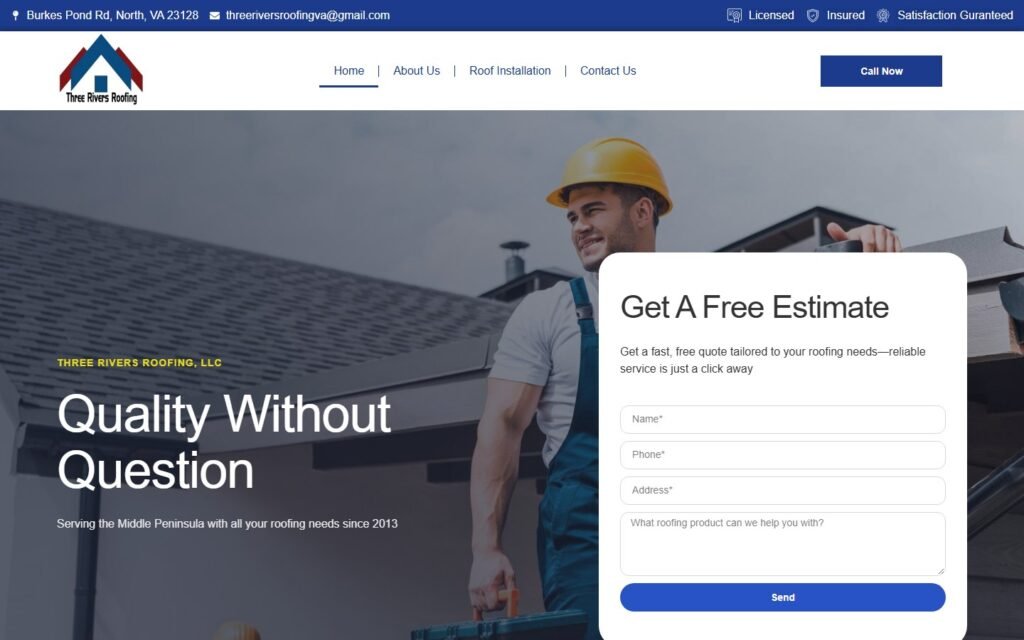
1. The estimate form goes where the eyes go
The first screen of the home page answers who you are and puts a short estimate form right next to it: name, phone, address and what they need. No hunting for a contact page. On a phone, a call button stays one tap away.
Keep the form short. Every extra field costs you leads. You can ask for details on the call.
2. One page for every service
“We do roofing” does not answer anyone’s question. A homeowner searching for a roof repair, a full replacement, storm damage or gutters wants a page about exactly that. Each service page should say:
- What the service is and when someone needs it.
- Where you offer it, by town and county.
- What happens from first call to finished job.
- What affects the price, even if you do not publish one.
- Photos of real jobs and a way to request an estimate.
Those pages are also what search engines and AI assistants read when they decide who to recommend. I explain that side in answer engine optimization for small business websites.
3. Proof, up front
Roofing is a trust purchase. Someone is about to let a stranger onto their house. Show the proof early:
- Star ratings and a few real reviews, with names where customers allow it.
- Licensed and insured, stated plainly near the top.
- How long you have served the area.
- Photos of your crew and your work, not stock images of a smiling model in a hard hat.
4. Forms that block spam, not customers
Contractor forms attract bots. A lead list full of junk wastes time and buries the real calls. Every form I build blocks bots without making real people solve puzzles, and every real lead goes straight to the owner’s inbox or CRM. If your leads need to land in a CRM, my post on Gravity Forms CRM integration covers how to keep that connection from failing.
5. Local search is half the job
For a roofer, the map listings and the local results matter as much as the website. The site and the listing should work together:
- Your name, address and phone number identical on the site, your Google Business Profile, Yelp and Facebook.
- Your service area named clearly on the site.
- A complete Google Business Profile with photos, services and hours. Google’s own tips on improving local ranking are a good checklist.
- Structured data that tells search engines you are a roofing contractor and where you work. Schema.org even has a RoofingContractor type. More on that in schema markup for small business websites.
6. Fast on a phone
Someone with water coming through the ceiling is not going to wait for a slow page. Compressed images, no heavy sliders and a short list of plugins keep the site quick on mobile data. My Core Web Vitals fix list has the details.
The same playbook works for other home services
Cleaning companies, pet waste removal, HVAC, landscaping and other home services follow the same pattern with one twist each. A cleaning company I built for lost bookings to phone tag, so the site got online booking with instant pricing and automatic reminders. A pet waste removal service needed recurring customers rather than one-off jobs, so the site was built around a subscription sign-up and local SEO. You can see both on my work page.
If your current site is holding you back, start with my website redesign checklist so you keep what already works.
Frequently asked questions
What should a roofing website include?
A clear headline with your service area, a short estimate form and a call button on the first screen, a page for each service, reviews and proof of licensing and insurance, real job photos, and consistent local business details.
How do roofing companies get more leads from their website?
Make contacting you effortless on a phone, answer the questions homeowners search for on dedicated service pages, show proof early, block spam so real leads stand out, and keep your local listings consistent with the site.
Do roofers need SEO?
Yes. Most homeowners search before they call, and many now ask Google’s AI or another assistant. A roofer whose site and listings answer those searches clearly gets the call.