Answer engine optimization, or AEO, is making your business the answer when people ask Google’s AI Overviews, ChatGPT or another assistant a question instead of scrolling through links. For a small business it comes down to three things: pages that answer real questions clearly, business details that match everywhere they appear online, and structure that machines can read without guessing.
I treat AEO as part of what I call True SEO, not as a separate trick. Here is what it is, why it matters now, and the changes that got a Virginia roofer recommended by Google’s AI.
Why answers matter more than rankings now
Search used to end in ten blue links. More and more often it now ends in a summary written by AI. A Pew Research Center study found that 58% of the Google users it tracked saw at least one AI summary in a single month. When a summary appeared, people clicked a regular result in 8% of visits, against 15% when there was no summary. They clicked a link inside the summary itself just 1% of the time.
That changes the goal. If fewer people click through, the business named inside the answer wins the call. Ranking third under an AI summary is worth less than being the company the summary tells people to contact.
What AEO is, and what it is not
AEO is not a hidden setting or a special tag. Google says plainly in its guide to AI features and your website that there are no extra requirements to appear in AI Overviews beyond the fundamentals of good SEO. Your pages need to be indexable, useful and clear.
What AEO adds is a way of writing and structuring a site so that the fundamentals produce answers, not only pages. It is the difference between a services page that says “we offer quality solutions” and one that says what you do, where you do it, how long it takes and what it costs.
The five things I build into every site for AEO
1. Answer the question in the first lines
Every important page and article opens with a plain answer to the question it exists for, in two or three sentences, before any story. AI systems lift clear statements. Vague introductions give them nothing to quote. You will notice every post on this blog starts that way.
2. Cover who, what, where, when, why and how
A page that says who you serve, what you do, where you work, when you are available, why you are different and how the process goes answers most of the questions people ask an assistant about a business like yours. Missing any of those leaves a gap a competitor fills.
3. Keep your business details identical everywhere
Your name, address, phone number and service area should match on your site, your Google Business Profile, Yelp, Facebook and every directory. AI answers are stitched together from several sources. When they agree, the answer is confident. When they conflict, you get left out.
4. Use structured data
Schema markup tells machines in a fixed format what a page is about: your business, your services, your reviews, the questions on the page. It does not guarantee anything, but it removes guesswork. I explain which types a small business needs in schema markup for small business websites.
5. Write question sections people actually ask
Short question and answer sections, written from real customer questions, give both search engines and assistants ready-made answers. The questions should come from your phone calls and emails, not from a keyword tool.
How a roofer became Google’s answer
Three Rivers Roofing had five-star reviews and a website that looked like it took five minutes: a few paragraphs, a contact button, no real service information and no SEO. I rebuilt it with True SEO and AEO: service pages that answer what homeowners ask, a lead capture page, consistent business details and forms that block spam. Organic leads went from 2 or 3 a month to 1 to 3 a day.
Then something better happened. Search “roof is leaking” in their area, and Google’s AI Overview tells people to contact Three Rivers Roofing and gives their phone number.
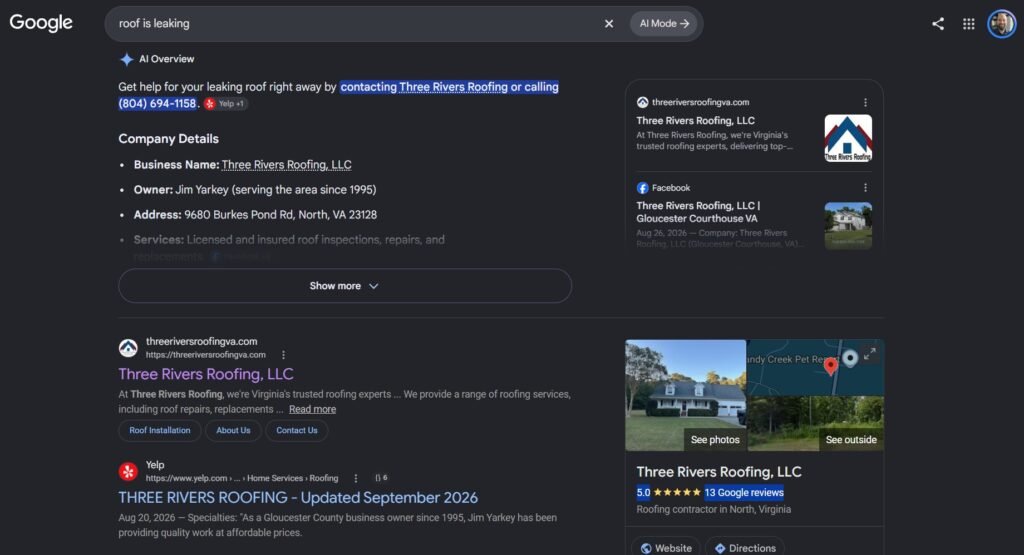
Look at where that answer came from: their own site, plus Yelp and Facebook. That is the consistency point in action. The full story is in the Three Rivers Roofing case study, and the design side is in roofing website design that turns visitors into calls.
What does not work
- Stuffing keywords. AI summaries reward clear answers, not repetition.
- Thin pages for every town. A hundred near-identical location pages read as spam to people and to machines.
- Relying on an SEO plugin’s green light. A plugin can check boxes. It cannot write the answer or make your business details agree. I go into that on my SEO Illusion page.
- Blocking the crawlers you want to be quoted by. If you want AI search tools to recommend you, they need to be able to read your site.
Where to start this week
- List the ten questions customers ask you most.
- Make sure each one is answered clearly on your site, near the top of the right page.
- Check that your name, address, phone and hours match on your site, Google, Yelp and Facebook.
- Ask Google and ChatGPT those questions yourself and see who gets named.
Frequently asked questions
What is the difference between SEO and AEO?
SEO is about earning a place in search results. AEO is about being the answer an AI summary or assistant gives. They share the same foundation, but AEO puts more weight on clear, quotable answers and consistent business details.
Can I pay to be named in Google’s AI Overviews?
Not in the answer itself. Google can show labeled ads near an AI Overview, but the businesses the summary names come from pages that are indexed and answer the question well.
How long does AEO take to work?
It depends on how often search engines revisit your site and how competitive your market is. Clear answers and consistent details tend to show results within a few months, and they keep working because they also improve regular SEO.
Does AEO work for local businesses?
Yes, especially for them. Many questions people ask assistants are local, like who can fix a leaking roof nearby. A local business with clear answers and matching details everywhere is exactly what those answers need.